
Commercial tyre failures account for over 30% of unplanned live-lane freight stops across the London orbital motorway. When a sudden blowout strands a loaded artic between junctions, securing rapid lorry tyre assistance M25 drivers can rely on becomes an immediate priority. Sitting beside high-speed traffic on a hard shoulder or emergency refuge area puts your driver at serious risk, whilst tight freight delivery windows quickly slip away.
You already know that every lost minute drains profit and burns through precious driver tachograph hours. Unclear arrival times from generic recovery call centres simply aren’t acceptable when your fleet’s schedule is on the line. Discover how to secure rapid roadside lorry tyre assistance on the M25 to minimise fleet downtime safely. We outline the certified roadside fitting procedures, DVSA roadworthiness standards, and rapid commercial dispatch networks that get heavy goods vehicles rolling again across Essex, Kent, and Greater London.
Key Takeaways
- Immediate safety protocols for positioning a disabled commercial rig within smart motorway Emergency Areas to eliminate live-lane collision risks.
- Proven methods to secure rapid lorry tyre assistance M25 hauliers rely on for quick dispatch and transparent upfront pricing.
- Technical guidelines for identifying exact commercial tyre specifications and axle requirements to maintain strict DVSA roadworthiness compliance.
- Professional roadside replacement standards, including safe exclusion zones, heavy commercial jacking, and calibrated wheel torque procedures.
- Essential fleet tyre management practices that prevent heat-induced blowouts before vehicles leave transport depots across Essex, Kent, and London.
Emergency Protocol: What to Do in an M25 Lorry Tyre Failure
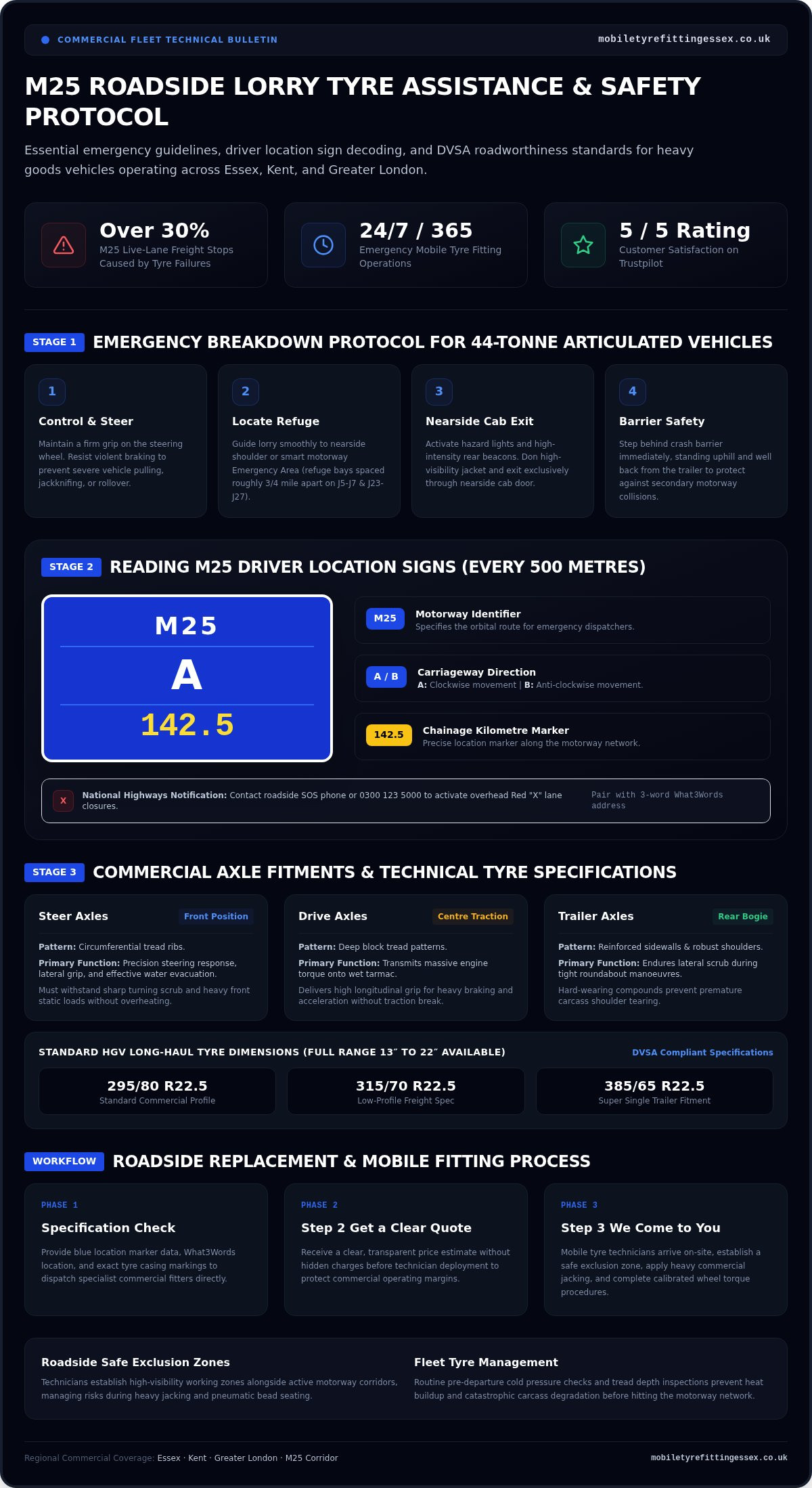
A sudden tyre blowout on a 44-tonne articulated lorry demands instant, disciplined action. Heavy freight traffic moves relentlessly along the M25 orbital motorway, leaving zero margin for error when steering a crippled rig across active lanes. Your immediate priority is getting the vehicle off the carriageway before contacting a dedicated breakdown provider for lorry tyre assistance M25 operators trust.
Securing the Heavy Commercial Vehicle Safely
Keep a firm grip on the steering wheel and resist the urge to brake violently. Sudden deceleration pulls the vehicle toward the blown tyre, risking jackknifing or a total rollover. Guide the lorry smoothly toward the nearside shoulder or an Emergency Area. On All Lane Running sections between Junctions 5 and 7 in Kent or Junctions 23 and 27 across Essex, aim for the designated refuge bays spaced roughly three-quarters of a mile apart.
Once stopped, follow these non-negotiable safety rules:
- Activate all hazard lights and switch on high-intensity rear beacons to alert approaching traffic.
- Exit exclusively through the nearside cab door to ensure you never step into live motorway lanes.
- Wear a high-visibility jacket before stepping down from the cab footwell.
- Step behind the safety barrier immediately, standing uphill and well back from your trailer to guard against secondary collisions.
Identifying Your Exact Motorway Position
Generic recovery call centres often waste precious hours guessing where a disabled lorry is parked. Precise location data ensures rapid dispatch of our mobile tyre technicians across key orbital routes. Do not rely on vague descriptions like “somewhere near the Dartford Crossing”.
Look at the verge or central reservation to locate the nearest blue driver location sign, positioned every 500 metres. These signs display three vital pieces of data:
- The motorway identifier (e.g. M25).
- The carriageway letter (“A” denotes clockwise movement; “B” indicates anti-clockwise travel).
- The exact location marker (a precise chainage kilometre number, such as 142.5).
Pair this data with a 3-word What3Words address from your smartphone. Contact National Highways via the roadside orange SOS phone or 0300 123 5000 so control rooms can activate overhead Red “X” lane closures. Then call for professional emergency roadside tyre service. Providing these precise details enables specialist fitters to reach you directly with the correct commercial equipment, restoring transit without unnecessary tachograph disruption.
Selecting the Correct Replacement Tyre for Heavy Commercial Vehicles
Fitting the wrong tyre on an articulated lorry invites catastrophic failure and immediate DVSA prohibition notices. Heavy goods vehicles carry massive static loads and withstand immense rotational torque. When calling for emergency lorry tyre assistance M25 operators must communicate precise axle positions and casing dimensions to ensure technicians arrive with the correct equipment.
Steer, Drive, and Trailer Axle Requirements
Each axle on an HGV performs a distinct mechanical duty. Fitting a generic commercial tyre across any position compromises road handling and breaches commercial transport regulations:
- Steer Axles: These demand circumferential tread ribs engineered for precision steering response, lateral grip, and effective water evacuation. Steer tyres must handle sharp turning scrub and heavy front axle loads without overheating.
- Drive Axles: Requiring deep block tread patterns, drive tyres transmit massive engine torque onto wet tarmac. They provide high longitudinal grip for braking and acceleration without breaking traction.
- Trailer Axles: Trailer fitments face extreme lateral forces and scrub during tight roundabout manoeuvres. Reinforced sidewalls and hard-wearing shoulder compounds prevent shoulder tearing and premature carcass wear.
Reading Commercial Tyre Size Markings Roadside
Examining tyre markings on a dark motorway shoulder can feel daunting. Stand in a safe position behind the crash barrier in line with Highway Code breakdown safety rules, using a torch to inspect the casing markings before requesting roadside fitment.
Look for three essential data points stamped into the sidewall rubber:
- Dimensions: Standard long-haul sizes appear as 295/80 R22.5, 315/70 R22.5, or 385/65 R22.5. This tells the fitter the nominal width, aspect ratio, and rim diameter in inches.
- Load and Speed Index: Commercial markings show dual numbers, such as 156/150K. The first number denotes maximum load capacity for single fitments (steer and trailer axles), while the second covers dual fitments on drive axles. The letter indicates the certified maximum speed rating.
- Ply and Inflation Ratings: Commercial ply ratings confirm carcass strength under high pressure. Ensure your mobile technician supplies matching ply specifications that can safely hold 8 to 9 bar operating pressures.
Fitting premium tyre brands on motorway haulage rigs delivers superior safety grip and reduces repeat puncture risks. For swift dispatch and certified roadside replacements across Essex, Kent, and London, partner with proven professionals like Mobile Tyre Fitting Essex to secure tailored fleet vehicle tyre solutions.
Step-by-Step Guide to Organising Roadside Lorry Tyre Assistance
Every minute a commercial vehicle sits immobilised on the orbital motorway, operating costs escalate. Securing fast lorry tyre assistance M25 transport managers can depend on requires a clear, decisive protocol. Dialling a dedicated 24 hour mobile tyre fitting team cuts through generic call-centre delays. You move straight to Step 2 Get a Clear Quote with upfront pricing transparency, followed by Step 3 We Come to You with commercial vans fully equipped to handle roadside emergency HGV tyre repair.
Relaying Critical Fleet and Vehicle Information
Mobile tyre technicians need precise operational facts before dispatching a service van. Providing detailed vehicle specifications prevents delays and ensures an exact mechanical fitment roadside:
- Vehicle configuration and load status: State whether the lorry is running laden or empty, along with its gross vehicle weight class. Heavy axle weights dictate the type of lifting equipment required.
- Exact wheel position: Clearly identify the affected corner, whether it is a nearside steer tyre, an offside trailer tag, or an inner drive axle dual.
- Rim condition: Report whether running flat caused bead deformation, structural wheel flange damage, or stud shearing.
- Wheel fixings: Inform the team if standard commercial wheel nuts are fitted, or if a seized, corroded nut requires specialist tooling. If your fleet utilises wheel security locks, our crew can deploy a mobile locking wheel nut removal Essex service for fast, safe removal without damaging the wheel studs.
Coordinating Fast Dispatch Across M25 Hotspots
Congestion hotspots around the Dartford Crossing, Junction 28 for Brentwood, and Junction 30 for Thurrock demand strategic fleet deployment. Specialist mobile tyre fitting experts monitor live orbital traffic patterns, dispatching support vehicles along the quickest access routes across Essex, Kent, and Greater London.
Service vehicles carry high-tonnage commercial air jacks, industrial pneumatic bead breakers, and pre-calibrated torque wrenches. Fleet managers receive real-time technician progress updates, allowing transport offices to recalculate delivery schedules accurately. This customer-focused service ensures replacements meet the strict standards outlined in the DVSA Guide to Maintaining Roadworthiness, protecting your operator licence while getting freight back in motion.
On-Site Tyre Replacement: What Happens During Mobile Fitting
Replacing an HGV tyre along a busy motorway corridor requires rigorous safety measures and specialised heavy equipment. Professional mobile tyre fitting experts do not treat an articulated rig like a passenger vehicle. When executing lorry tyre assistance M25 roadside call-outs demand, technicians follow strict commercial procedures designed to safeguard personnel and restore vehicle roadworthiness efficiently.
Arrival begins with establishing a secure physical barrier. The service vehicle parks in a protective fend-off position upstream of the stranded lorry, displaying high-intensity amber beacons to deflect oncoming traffic. The technician completes an immediate dynamic risk assessment before unpacking heavy hydraulic machinery.
Wheel Removal and Rim Safety Inspection
Technicians slacken the massive wheel fixings while the vehicle’s tyres remain firmly planted on tarmac. Breaking the initial thread resistance prevents dangerous hub rotation while the axle sits elevated:
- Commercial Axle Jacking: The engineer positions high-tonnage pneumatic bottle jacks directly under approved chassis or axle lifting points, inserting mechanical safety axle stands before work commences.
- Wheel Assembly Demounting: After removing the loosened nuts, mechanical wheel-handling dollies support the heavy wheel assembly, sliding it clear of the hub without straining wheel studs.
- Structural Flange Inspection: Technicians wire-brush the hub face and rim bead seating area. They check for elongated bolt holes, hairline fatigue cracks around the nave plate, and heavy corrosion that could prevent a flat, secure fitment.
Mounting, Inflation, and Precision Re-Torquing
Technicians mount the replacement commercial casing using heavy-duty bead clamps and specialised tyre lubricant. Roadside commercial inflation demands strict containment protocols to prevent explosive pressure release:
- Inflation Safety Protocols: The tyre sits within a dedicated mobile containment cage or uses remote clip-on chucks with inline gauges, allowing the technician to stand well outside the trajectory zone.
- Cold Pressure Delivery: Tyres receive precise inflation, typically calibrated between 8 and 9 bar (116 to 130 PSI), aligned with the vehicle’s gross weight ratings.
- Calibrated Re-Torquing: Technicians mount the wheel assembly, hand-tightening all fixings before lowering the axle. Using a calibrated torque wrench, they torque the wheel nuts in a strict criss-cross sequence to exact manufacturer figures, typically 600 to 650 Nm for standard M22 studs.
To eliminate dangerous roadside delays and protect your commercial operating licence, book mobile tyre fitting now for instant roadside dispatch across the London orbital network.
Preventative Fleet Tyre Management for Motorway Haulage
Stopping blowouts before lorries enter the London orbital corridor is far more cost-effective than calling for emergency rescue. High motorway speeds combined with heavy axle loads generate tremendous internal tyre heat, accelerating casing degradation when pressures drop. While rapid lorry tyre assistance M25 hauliers depend on resolves active breakdowns, disciplined fleet maintenance prevents vehicles from being stranded in the first place.
Daily Driver Walk-Around Tyre Inspections
Daily driver walk-around checks remain your frontline defence against catastrophic failures. Transport operators must ensure drivers complete systematic, depot-level checks every morning before leaving yards across Essex, Kent, Cambridge, or London:
- Foreign Object Penetration and Cuts: Check the entire circumference of the tread for embedded flints, metal shards, and deep cuts that penetrate the casing cords.
- Sidewall Condition: Look closely for bulges, blisters, or deep scuffs indicating internal radial cord separation, often caused by depot kerbing or tight loading bay turns.
- Valve Caps and Seals: Confirm all metal or hard plastic valve caps are screwed tight. Missing caps allow road grit to contaminate Schrader valves, causing slow, undetectable air leaks.
- Tread Depth Inspection: Perform regular tread depth inspection routines across all axle sets. HGVs require at least 1 mm across the central three-quarters, but replacing tyres well before this legal threshold prevents wet-weather loss of control.
Long-Term Fleet Tyre Management Strategies
Modern transport logistics demands proactive planning rather than reactive panic. Coordinating dedicated fleet tyre management across your tractor units and trailers keeps commercial vehicles compliant with DVSA roadworthiness standards while keeping operating costs predictable.
Implementing bespoke fleet vehicle tyre solutions allows hauliers to schedule preventative casing replacements, torque checks, and pressure audits during routine rest periods. When unexpected debris or road hazards strike, having a pre-established plan for emergency HGV tyre repair across orbital motorway routes guarantees immediate response from certified mobile tyre technicians. Fleet managers can monitor tyre longevity, review wear patterns to diagnose suspension issues, and avoid high-stress motorway disruptions altogether.
Keep your freight rolling smoothly and protect your haulage deadlines across the South East. Experience rapid roadside rescue today with Mobile Tyre Fitting Essex for dependable 24/7 commercial fleet support.
Restore Motorway Transit with Rapid Commercial Assistance
Commercial vehicle blowouts on the orbital motorway demand swift, disciplined action. Positioning your rig securely within designated refuge areas, communicating exact tyre load ratings, and deploying certified mobile engineers protect both your driver and your freight schedule. When transit halts, you need dependable lorry tyre assistance M25 fleets rely on to eliminate costly downtime without compromising safety.
Don’t let unexpected punctures disrupt your transport network. Mobile Tyre Fitting Essex operates 24/7, 365 days a year, delivering dedicated roadside solutions across Essex, Kent, London, and Cambridge. Backed by a 5/5 rating on Trustpilot from commercial operators, our technicians reach stranded HGVs swiftly with heavy pneumatic equipment and premium tyre brands suited for demanding motorway haulage.
Keep your fleet compliant, protect your operator licence, and safeguard your delivery deadlines. Call our 24/7 dispatch desk now or book your emergency mobile tyre fitting to secure immediate roadside assistance and get your vehicle rolling again.
Frequently Asked Questions
How quickly can a mobile tyre fitter reach an HGV stranded on the M25?
Our mobile tyre technicians aim to reach stranded commercial vehicles along the M25 within 30 to 60 minutes of dispatch. Response times depend on current orbital traffic conditions and your exact marker post, but our strategic positioning across Essex, Kent, and London ensures rapid deployment. We operate 24 hours a day, 365 days a year, prioritising hazardous motorway incidents to minimise live-lane exposure and keep driver tachograph disruption to an absolute minimum.
Can an HGV lorry tyre be repaired roadside on the M25, or is replacement required?
Minor tread punctures can occasionally undergo puncture repair if the casing remains completely undamaged and meets strict British Standard BS AU 159 regulations. However, most high-speed motorway failures involve catastrophic internal cord delamination, thermal blowout damage, or sidewall tearing. In those scenarios, full roadside replacement is mandatory to satisfy DVSA roadworthiness standards. Our mobile units always arrive with suitable replacement commercial tyres to ensure you aren’t left stranded if a repair is unsafe.
What information must I provide when booking emergency HGV tyre repair?
You must supply your exact motorway marker post, direction of travel, and What3Words location, alongside your full tyre size markings. Inform our dispatch team of the specific wheel position, axle type, and whether the vehicle is laden. When calling for lorry tyre assistance M25 dispatchers also need to know if any wheel studs are sheared, if rims are damaged, or if security fixings require our specialist lock nut removal service.
Is mobile tyre fitting permitted on smart motorway Emergency Areas?
Yes, certified mobile tyre technicians are permitted to change commercial tyres within smart motorway Emergency Areas once the site is properly secured. Drivers must inform National Highways via the roadside orange SOS emergency telephone or control room so overhead Red “X” lane closures can be initiated if necessary. Technicians follow strict roadside safety protocols, parking service vehicles in an upstream fend-off position with amber warning beacons active before commencing work.
Do your mobile tyre technicians carry tyres for heavy trailers and multi-axle units?
Yes, our service vehicles carry a broad inventory of commercial tyres ranging from 17.5 to 22.5 inches, including specialised trailer and multi-axle fitments. We supply heavy-duty, high-scrub casings designed specifically for tri-axle semi-trailers, low loaders, and heavy distribution rigs operating across Essex, Kent, and Greater London. Our mobile tyre technicians ensure your replacement matches the exact axle weight requirements, ply ratings, and speed indices mandated for full fleet compliance.
What happens if the wheel nuts on my commercial vehicle are damaged or corroded?
Damaged, seized, or corroded nuts are extracted roadside using heavy-duty commercial impact equipment and specialist removal tools. Road salt and excessive torque often seize commercial studs along orbital freight corridors, but our technicians resolve these obstacles without damaging the wheel hub. For operators using fleet security locks or facing stubborn fixings, we provide a dedicated lock nut removal service that ensures fast, safe removal so your lorry tyre assistance M25 recovery proceeds without delay.
