
A blown commercial tyre on the M20 or the Dartford Crossing does not just stall a vehicle; it halts your entire supply chain. When a loaded lorry breaks down along vital freight corridors approaching Dover, waiting hours for a conventional recovery truck creates severe delivery penalties and major DVSA compliance risks. You need immediate, reliable HGV mobile tyre repair Kent logistics operators can depend on 24 hours a day, 365 days a year.
Every transport manager knows that roadside downtime drains operational profit faster than almost any other fleet issue. In this guide, you will discover how rapid 24/7 roadside HGV tyre repair across Kent minimises downtime and keeps commercial fleets compliant with strict safety regulations. We will examine critical BS AU 159 repair standards, essential motorway safety rules, and the reasons mobile commercial tyre units outperform static depots to protect your haulage deadlines.
Key Takeaways
- Explore how rapid HGV mobile tyre repair Kent services eliminate costly logistics delays and maintain transport schedules across critical freight routes like the M20 and A20.
- Understand the precise British Standard BS AU 159 criteria that determine whether an on-site commercial puncture repair is legally permissible or if full casing replacement is mandatory.
- Master the correct emergency breakdown protocols to safeguard drivers and vehicles on high-speed motorways while remaining compliant with Highway Code rules.
- Discover the critical load indexes, speed ratings, and casing requirements necessary to select the right fleet vehicle tyre solutions for articulated lorries.
- See how partnering with dedicated commercial mobile tyre fitting experts operating 24/7 protects your operator licence against severe DVSA penalties.
Emergency HGV Tyre Failure in Kent: Risks and Rapid Roadside Response
An emergency commercial blowout is an urgent operational crisis. Unlike light passenger cars, a tyre failure on a 44-tonne articulated lorry demands immediate, heavy-duty on-site intervention. Haulage fleets cannot afford to wait for conventional recovery trucks or rely on depot-based appointments. Prompt HGV mobile tyre repair Kent units resolve blowouts directly where they happen, replacing damaged rubber and getting freight moving again without prolonged layovers.
Every commercial vehicle failure presents severe roadside hazards. When high-pressure truck tyres burst at motorway speeds, shedding heavy rubber casings, surrounding traffic faces immediate peril. According to established heavy goods vehicle (HGV) classifications and gross combination mass guidelines, commercial axles carry immense weight. An immobilised truck quickly blocks live running lanes or becomes dangerously pinned on narrow verges, making rapid on-site attendance vital.
High-Traffic Corridors and Freight Disruption in Kent
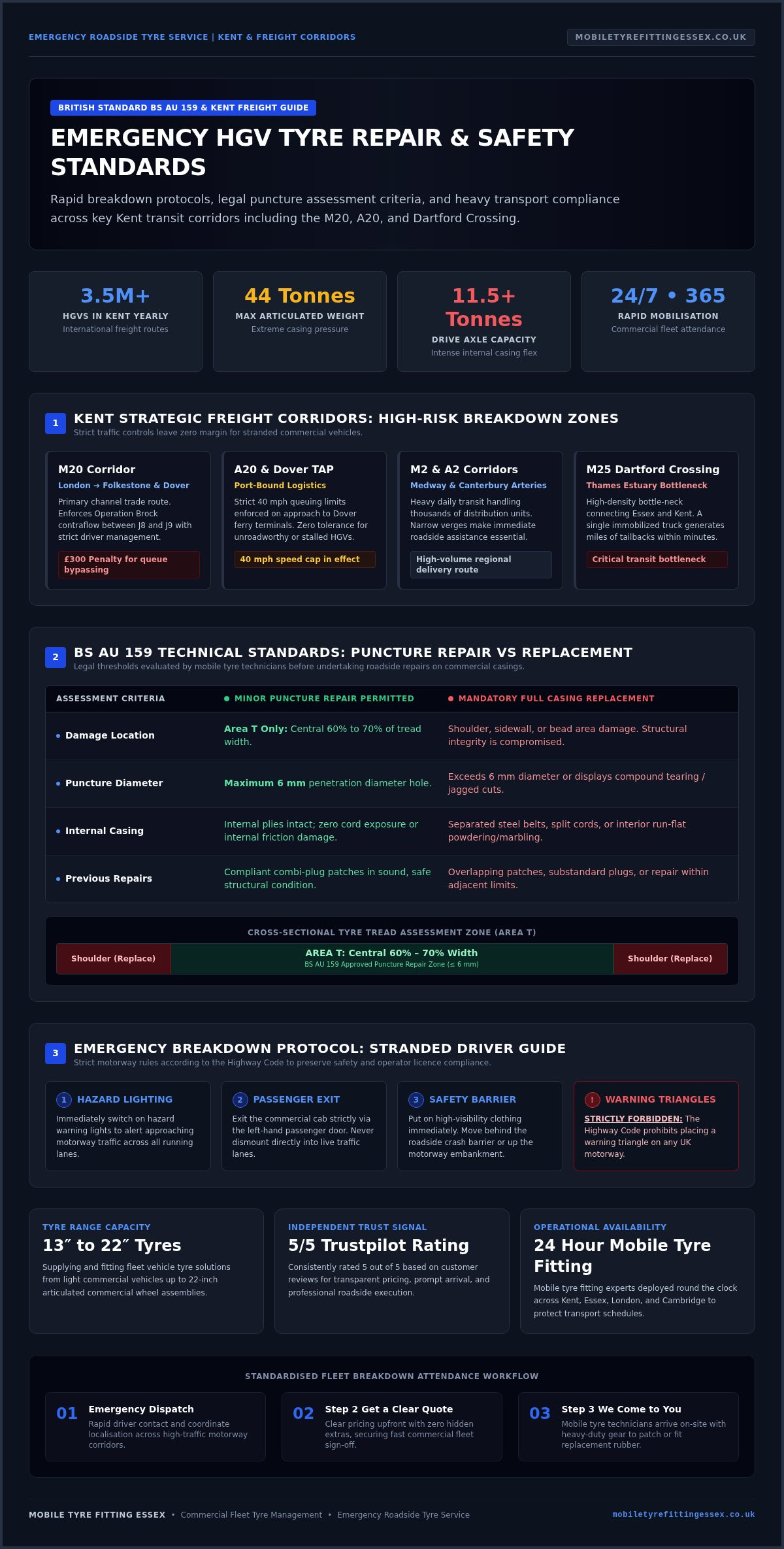
Kent sits at the epicentre of Britain’s international haulage network. Over 3.5 million HGVs travel through the county every year, concentrating heavy commercial traffic along critical arteries:
- M20 Corridor: The primary trade route linking London to Folkestone and Dover, subject to active traffic controls.
- A20 and Dover TAP: Enforces strict 40 mph queuing limits for port-bound freight, leaving zero margin for stranded vehicles.
- M2 and A2: Demanding routes that carry thousands of heavy delivery units across Medway and Canterbury daily.
- M25 Dartford Crossing Approaches: Bottlenecks where a single stopped lorry creates miles of tailbacks in minutes.
Strict regional traffic management schemes like Operation Brock between Junction 8 and Junction 9 of the M20 leave little room for error. Drivers caught bypassing queuing systems face £300 fixed penalty notices. When tyre failures occur inside these restricted corridors, immobilised trucks quickly snarl international trade. Dedicated roadside technicians dispatch quickly to clear breakdowns before congestion spirals.
Financial and Safety Repercussions for Commercial Operators
Unplanned vehicle stoppages trigger sharp operational losses. Missing a scheduled cross-Channel ferry slot or Eurotunnel train booking creates compounding delay penalties. Deliveries run late, refrigerated loads face spoilage risks, and hauliers breach strict customer contracts. Transport managers depend on immediate emergency HGV tyre repair to bypass stationary depot queues and save their delivery windows.
While awaiting an emergency roadside tyre service, drivers must follow strict motorway safety rules. The Highway Code strictly prohibits placing a warning triangle on a motorway. Drivers must activate hazard warning lights, exit the cab via the passenger-side door, wear high-visibility clothing, and wait behind the safety crash barrier. Rapid mobile response teams secure the site promptly, protecting vulnerable cargo and restoring legal compliance without unnecessary delay.
Roadside HGV Tyre Puncture Repair vs Replacement: Standards and Safety
Deciding whether to patch or replace a punctured commercial tyre requires strict technical assessment. Heavy haulage vehicles impose immense mechanical pressure on rubber compounds. A single drive axle can carry over 11.5 tonnes, generating intense internal friction and casing flex. Selecting the wrong solution invites catastrophic blowout risks. When operators request rapid HGV mobile tyre repair Kent services, attending technicians first evaluate whether the tyre meets precise British safety thresholds before performing work.
| Assessment Criteria | Minor Puncture Repair Permitted | Mandatory Tyre Replacement |
|---|---|---|
| Damage Location | Central 60% to 70% of tread width (Area T) | Shoulder, sidewall, or bead area |
| Puncture Diameter | Maximum 6 mm penetration hole | Exceeds 6 mm or shows tearing |
| Internal Casing | Plies intact; no interior cord exposure | Separated belts, split cords, or run-flat marbling |
| Previous Repairs | Compliant combi-plug patches in sound condition | Overlapping patches or non-standard external plugs |
Understanding British Standard BS AU 159 for Heavy Vehicles
Every legitimate roadside intervention must satisfy BS AU 159g:2013 standards. This regulation restricts puncture repairs strictly to the central tread zone, known as Area T. If road debris penetrates the shoulder or sidewall, the tyre cannot be salvaged. Technicians must demount the tyre from the rim to inspect the inner liner thoroughly. External string plugs inserted from the outside do not conform to UK road law for permanent commercial use. A compliant fix demands a bonded internal combination patch-plug unit to seal the puncture channel against moisture ingress.
When Commercial Replacement Becomes Legally Unavoidable
Structural damage leaves no room for compromise. Driving even a few hundred yards on an under-inflated commercial tyre causes severe sidewall overheating and internal ply separation. Once steel cords crack or the bead chafes, casing strength disappears completely. Fleets operating under the DVSA guide to maintaining roadworthiness must conduct daily walkaround checks and ensure zero compromised rubber runs on UK tarmac.
Compliance checks carry severe statutory consequences. Commercial HGVs over 3,500 kg gross weight must maintain at least 1.0 mm of tread depth across a continuous band covering the central three-quarters of the tyre. Driving on illegal rubber can trigger fines reaching up to £2,500 per tyre, alongside immediate PG9 prohibition notices against your operator licence. Commercial steering axles face even tighter controls; tyres over ten years old remain strictly banned on front steer positions. If your haulage fleet faces unexpected tyre degradation on regional trade routes, arranging prompt mobile tyre fitting guarantees full compliance before your vehicles rejoin active traffic.
Selecting the Right Commercial Fleet Tyre Solutions Across Kent
Fitting the wrong casing to a heavy articulated lorry invites premature failure. Commercial haulage requires tailored fleet vehicle tyre solutions engineered for extreme axle loads and long-distance friction. Transport managers cannot treat tyre selection as a generic purchase. Axle placement, load indexing, speed ratings, and carcass reinforcement dictate whether a tyre lasts 100,000 miles or blows out under pressure. When dispatching HGV mobile tyre repair Kent units to freight hubs in Maidstone, Ashford, or Dartford, technicians match exact tyre specifications to the vehicle’s commercial duty cycle.
Load index numbers confirm maximum carrying capacity per wheel, while speed symbols dictate operational heat thresholds. A tri-axle semi-trailer demands entirely different sidewall reinforcement compared to a front steer axle on a 6×2 tractor unit. Miscalculating these variables risks catastrophic roadside delamination.
Axle-Specific Demands for Heavy Commercial Lorries
Commercial tyre performance depends directly on axle role. Each position serves an entirely distinct operational purpose:
- Steer Axles: Demand longitudinal groove patterns for precise directional control, rapid water evacuation, and high braking grip.
- Drive Axles: Require block-tread geometry to transfer engine torque effectively across wet, icy, or uneven road surfaces.
- Trailer Axles: Need reinforced shoulder ribs to withstand immense lateral scrubbing forces when turning tight roundabouts or docking at distribution depots.
Cross-fitting tyres across inappropriate axles creates severe handling instability. If a blowout forces an emergency roadside replacement, drivers must ensure the replacement matches the axle requirements while maintaining mandatory Highway Code breakdown safety rules while the vehicle is stationary.
Premium Tyre Brands and Fleet Economy Strategies
Selecting premium tyre brands delivers measurable operational savings over fleet lifecycles. Premium casings from manufacturers like Michelin, Bridgestone, Goodyear, and Continental use low rolling resistance silica compounds. Lower rolling resistance cuts haulage diesel consumption across long M20 runs to the coast.
Durable premium carcasses also allow professional re-grooving and multiple retread cycles, dramatically reducing total cost per kilometre. Integrating regular fleet tyre management audits ensures tyres maintain optimal safety grip, correct inflation, and lawful tread depth. Proactive casing management eliminates the sudden structural failures that lead to emergency motorway breakdowns.
Emergency Breakdown Protocol: Guide for Stranded Drivers
A high-speed tyre failure demands immediate, calm execution. Navigating a breakdown along fast-moving Kent carriage routes requires strict adherence to safety protocol before recovery begins. When your lorry suffers sudden deflation, following an orderly recovery procedure protects both the driver and oncoming traffic while accelerating your request for HGV mobile tyre repair Kent dispatchers can process without delay.
- Position the Vehicle: Steer smoothly onto the hard shoulder or into an emergency refuge area. Turn wheels away from active traffic lanes.
- Secure and Vacate: Switch on hazard warning lights. Put on a high-visibility vest before exiting via the passenger door, never into live traffic.
- Clear the Carriageway: Step over the safety barrier and stand upstream on the embankment, facing oncoming traffic.
- Call for Dispatch: Relay critical location and tyre data to roadside technicians to initiate emergency service.
Immediate Safety Measures on High-Speed Motorways
Never remain inside an immobilised lorry cab on an active motorway. If a heavy truck strikes a stranded vehicle, the consequences are catastrophic. Remember that deploying a warning triangle on a UK motorway is illegal under the Highway Code. Stay behind the crash barrier, keep pets or co-drivers clear of the carriageway, and alert National Highways if your vehicle obstructs a live running lane.
Relaying Crucial Vehicle Data to Mobile Dispatch
Precision speed up roadside response times. When contacting dispatch, supply exact vehicle details:
- Tyre Markings: Read the full sidewall sequence (such as 315/80 R22.5), noting load ratings and axle position.
- Location Data: State the nearest motorway marker post numbers, junction references, or a three-word address via What3Words.
- Fixing Condition: Note if wheel fixings show signs of rust or damage; heavily stripped fixings or a mobile locking wheel nut removal requirement needs specialist tooling.
If a corroded nut resists roadside impact guns, inform the call handler so technicians arrive equipped for fast, safe removal.
What to Expect During the Roadside Service
Dispatch follows a streamlined process. Under Step 2 Get a Clear Quote, you receive transparent, upfront pricing with zero hidden charges. Once confirmed, Step 3 We Come to You mobilises custom heavy-duty mobile vans carrying pneumatic bead-breakers and high-torque impact wrenches directly to your location.
Upon arrival, the mobile technician establishes safety cordons, lifts the axle using industrial air jacks, and completes the replacement or BS AU 159 repair. Before releasing the vehicle, the fitter uses a calibrated commercial torque wrench to secure all wheel fixings to manufacturer specifications. For urgent roadside assistance across the South East, book your 24/7 mobile tyre fitting service now.
24/7 Mobile Tyre Technicians: Reliable Kent Fleet Support
Static tyre depots do not match the tempo of cross-Channel haulage. When a 44-tonne artic suffers roadside deflation at two in the morning, a brick-and-mortar garage opening at eight is worthless. Haulage operators require agile roadside allies who deploy specialised workshops straight to the breakdown site. Working with dedicated mobile tyre fitting experts ensures commercial vehicles receive round-the-clock roadside intervention every single day of the year.
Professional mobile response services safeguard operational margins. Backed by a 5/5 rating on Trustpilot reviews, our customer‑focused service pairs honest pricing with rapid attendance, guaranteeing your drivers are never left stranded without a plan.
Fully Equipped Mobile Commercial Workshops
Commercial roadside fitting requires immense mechanical force. Heavy goods vehicles cannot be serviced with ordinary car tools. Our custom-engineered long-wheelbase vans operate as mobile workshops carrying industrial-grade equipment:
- High-Capacity Air Compressors: Delivering sustained pneumatic volume required to seat heavy commercial beads and rapidly inflate massive truck tyres.
- Heavy Pneumatic Air Jacks: Safely raising fully laden tractor units and tri-axle semi-trailers on uneven road shoulders.
- Industrial Bead-Breakers: Separating stiff, multi-ply commercial tyres from steel and alloy rims without damaging the wheel seat.
- Torque Multipliers: Generating upwards of 600 Nm of torque to loosen stubborn wheel fixings and overcome any severely seized or corroded nut.
Every commercial roadside installation concludes with precise, calibrated torque procedures. Technicians hand-torque every stud to manufacturer tolerances, eliminating the severe risks of wheel-off incidents.
Direct Access to 24 Hour Mobile Tyre Fitting in Kent
Speed is everything when logistics schedules are at stake. Dedicated mobile tyre technicians maintain rapid response times across primary Kent freight routes, targeting arrivals within 40 to 60 minutes. Strategically positioned mobile units cover critical transport hubs:
- Dartford & Swanley: Managing heavy M25 border congestion and Dartford Crossing freight approaches.
- Maidstone & Ashford: Providing continuous coverage along the middle stretch of the M20 motorway.
- Dover & Folkestone: Delivering immediate assistance for ferry and Eurotunnel departures along the A20.
- Medway & Canterbury: Keeping freight rolling smoothly along the busy M2 and A2 dual carriageways.
Logistics operators cannot afford to gamble on depot opening hours. Choosing a dependable provider for your HGV mobile tyre repair Kent needs ensures reliable 24 hour mobile tyre fitting that protects your compliance, drivers, and delivery promises.
Secure Fast, Compliant Roadside Support for Your Commercial Fleet
Commercial haulage leaves zero margin for roadside delays. Rapid on-site interventions protect strict delivery schedules, eliminate punitive supply chain fines, and ensure rigorous DVSA compliance. Whether repairing a punctured tread under BS AU 159 standards or fitting premium tyre brands at the roadside, dependable assistance keeps your transport business moving forward.
Our custom mobile workshops operate 24 hours a day, 365 days a year, carrying specialised heavy commercial vehicle equipment to handle demanding axle assemblies on site. Backed by a 5/5 rating based on Trustpilot reviews, our mobile tyre technicians deliver honest, transparent service across every major freight route from the Dartford Crossing down to the Port of Dover.
Don’t let tyre failure compromise your delivery deadlines or driver safety. Call our emergency mobile tyre technicians now for 24/7 Kent roadside assistance and secure the rapid HGV mobile tyre repair Kent fleet managers rely on to maintain total roadworthiness.
Frequently Asked Questions
Can an HGV tyre puncture be repaired at the roadside in Kent?
Yes, an HGV puncture can be repaired roadside if the damage is strictly confined to the central tread zone (Area T) and measures 6 mm or less. Attending mobile tyre technicians demount the tyre to inspect the inner casing for internal cord damage or run-flat delamination. If the puncture qualifies under British Standard BS AU 159, technicians fit an internal combi-plug patch on site. Severe shoulder, sidewall, or bead damage requires immediate tyre replacement.
How quickly can emergency mobile tyre fitting arrive at a stranded lorry in Kent?
Emergency response vans typically reach stranded lorries across Kent within 40 to 60 minutes. Technicians operate 24/7 across critical transport links, including the M20, A20, M2, and Dartford Crossing approaches. Immediate dispatch ensures commercial drivers avoid costly delivery delays and penalties associated with traffic management systems like Operation Brock or Dover TAP. Exact arrival times depend on live traffic flow and your precise roadside location.
What details must I provide when booking emergency HGV tyre repair?
State your exact location using What3Words, motorway marker posts, or junction numbers. Provide the full tyre size code stamped on the sidewall, such as 315/80 R22.5, alongside load and speed ratings. Specify whether the failure affects a steer, drive, or trailer axle, and note if any wheel fixings appear stripped or seized. Providing accurate vehicle details guarantees that your HGV mobile tyre repair Kent response team arrives with the precise replacement casing and tooling.
Do your mobile tyre technicians carry commercial tyres suitable for all HGV axles?
Yes, mobile response units stock a broad inventory of commercial tyres tailored to steer, drive, and trailer positions. Technicians carry standard commercial rim sizes including 17.5, 19.5, and 22.5 inches, alongside tyre sizes from 13 to 22 inches for mixed fleets. Whether your vehicle requires directional steer tyres or heavy-duty scrub-resistant trailer casings from premium tyre brands, technicians bring the exact specifications required directly to your roadside location.
Can a damaged locking wheel nut or corroded nut on an HGV wheel be removed roadside?
Yes, mobile technicians carry heavy-duty torque multipliers and specialised extraction tooling designed for fast, safe removal of seized hardware. When road grime, over-torquing, or weather exposure causes a corroded nut or damaged fixing, standard impact wrenches often fail. Technicians apply controlled pneumatic force to break the bond without damaging the wheel stud or hub assembly. This specialised roadside extraction eliminates the need for expensive commercial towing.
What safety standards govern commercial HGV tyre puncture repairs in the UK?
All roadside commercial repairs must adhere strictly to British Standard BS AU 159g:2013. This standard requires demounting the tyre for an internal inspection to confirm casing integrity. Puncture repairs are restricted to the central tread band and must be permanently sealed using a bonded combination patch-plug. External string plugs are illegal for permanent highway use. Repairs must also satisfy DVSA tread depth requirements of at least 1.0 mm across the central three-quarters of the tyre.
Are mobile commercial tyre services available 24 hours a day on Kent motorways?
Yes, roadside commercial support operates 24 hours a day, 365 days a year across all major Kent routes. Dedicated HGV mobile tyre repair Kent crews respond around the clock to emergencies on the M20, M2, A20, and M25. Whether your lorry suffers deflation on a motorway hard shoulder at midnight or in an emergency refuge area during rush hour, mobile teams deploy fully equipped vans to resolve the issue swiftly and safely.
