
A flat tyre on a motorway is first a safety issue, not a roadside repair. If you need assistance for a flat tyre on a motorway across our service areas including London, Essex, Kent and Cambridge, switch on your hazard lights after stopping safely, leave by the left-hand side and move behind a safety barrier if it’s safe to reach. If you’re stranded in a live lane and can’t get out safely, stay inside with your seatbelt fastened, switch on the hazards and call 999, according to the Department for Transport.
A flat tyre on a motorway can be stressful, especially when traffic is close and you’re unsure what to do next. The safest response depends on where your vehicle stops and whether you can reach a place of relative safety without entering live traffic.
This guide explains what to do straight away, when to call 999, and how to arrange help for a damaged tyre through specialists like Mobile Tyre Fitting Essex. You’ll also learn how mobile tyre assistance can fit into the next steps once you and your passengers are safe.
Key Takeaways
- Know why warning triangles and roadside tyre changes aren’t the right response on a motorway.
- Choose your next step based on whether you’re on a live lane, hard shoulder or emergency refuge area.
- Understand how round-the-clock emergency tyre assistance can help after a motorway puncture.
- Find out what details to provide when arranging help, so the tyre issue and location are clear.
- See when mobile tyre fitting or a puncture repair can get you moving again once it’s safe to receive assistance.
Should You Stay Inside or Leave the Car After a Motorway Tyre Breakdown?
First, decide whether you can leave the vehicle without stepping into live traffic. If you’ve stopped safely on a hard shoulder or in an emergency refuge area, switch on the hazard lights, then leave through the left-hand side. Move away from the carriageway and get behind a safety barrier if one is available and safe to reach.
Don’t inspect the tyre, take photographs or attempt a wheel change beside moving motorway traffic. Keep passengers together in a safe place, and wear reflective clothing if you have it. Use sidelights as well as hazard lights if visibility is poor. Don’t walk along the motorway to find a refuge area, and don’t place a warning triangle on a motorway.
If your vehicle is stranded in a live lane and you can’t reach relative safety or leave safely, stay inside with your seatbelts fastened. Switch on the hazard lights and call 999, asking for the police, according to the Department for Transport. Don’t get out to inspect the tyre or retrieve belongings while traffic is passing.
What are the rules for using a space-saver spare tyre in the UK? Treat it as a temporary wheel and follow the speed and distance limits in your vehicle handbook or on the spare, as these vary by vehicle and tyre. Arrange a suitable replacement as soon as practical rather than relying on the space-saver as a permanent fix.
How long does motorway breakdown assistance usually take in London? There’s no single arrival time: your exact position, traffic, safe access and the type of help needed all affect the wait. Give the call handler the motorway, direction of travel, nearest junction or refuge area, and any location marker details you can read safely.
Where there’s no hard shoulder, don’t stop in a live lane to change a tyre. If the vehicle can still move safely, aim for the next exit or service area. On a smart motorway, use the next exit or service station, or stop at an emergency refuge area if needed. A Red X means the lane is closed, so never drive beneath one.
Once you’re in a safe location, call for appropriate breakdown or tyre assistance and describe the damage, vehicle and exact position. A roadside professional can assess whether a repair or replacement is suitable there. Recovery services may sometimes make a temporary roadside repair, but the tyre’s condition determines the practical next step.
For any call, use a nearby location marker to help identify where you’ve stopped. Share your direction of travel and whether you’re on a hard shoulder, in a refuge area or beyond an exit. Stay clear of the carriageway while help is arranged, and follow instructions from emergency or breakdown personnel.
Warning triangles and roadside tyre changes
A warning triangle is not suitable for a motorway breakdown. Don’t take one from the boot or walk behind the vehicle to place it. Traffic can approach quickly, and leaving the vehicle to set out a triangle exposes you to moving vehicles. Keep the triangle packed away and focus on reaching a safe place and contacting assistance.
Changing a tyre beside a live motorway lane is not safe. Even on the hard shoulder, don’t treat a spare wheel and jack as permission to work beside traffic. The vehicle may be close to passing vehicles, and the ground may be uneven. Arrange appropriate help rather than removing a wheel yourself in that location.
Once you’re safely away from the carriageway, gather details that will help the call handler identify the job. From a safe position, note visible damage, such as a puncture or a fully deflated sidewall. Have your vehicle make and model, registration, tyre size if readily available, and exact location ready. Never step back into traffic to read the tyre or registration.
Ask for an upfront quote before agreeing to roadside assistance. The price depends on the case and is given after a quote request; factors include the tyre specification, whether repair or replacement is needed, your location and safe access to the vehicle. Describe the damage and vehicle accurately so the quote reflects the work being requested. Ask what the quoted amount covers, including any call-out or fitting charges, before accepting.
Give a clear location when arranging help. Use the motorway name, direction of travel, nearest junction, and a location marker number if one is visible from your safe position. For example, “M25 clockwise, near the next junction” is more useful than “outside London”. On a motorway without a hard shoulder, state whether you’re in an emergency refuge area or beyond the carriageway.
- Stay out of live traffic and don’t place a warning triangle.
- Don’t attempt to change a wheel beside motorway traffic.
- Share the vehicle details, tyre damage and precise location.
- Get the quote and understand its scope before accepting the job.
When the vehicle is safely accessible, roadside help can assess whether a puncture repair or replacement is suitable. For a tyre problem requiring on-site attention, you can arrange roadside tyre assistance after sharing the location and damage details.
24/7 Service availability
A 24/7 emergency tyre service can be contacted at any hour, including overnight, weekends and bank holidays. That matters when a puncture stops a journey outside normal daytime hours. Availability means you can arrange help without waiting for a garage to open. It doesn’t mean a technician can work beside live motorway traffic, so first reach a safe place and follow the motorway operator’s instructions.
Once safe, make the call with the key details ready. State the motorway, direction of travel, nearest junction or service area, and whether the car is in a refuge area or another safe location. Give the vehicle make and model, registration, and a clear description of the tyre damage. These details help the team understand whether you need a repair or replacement.
At night, your location may be harder to identify. Use a location marker number if it’s visible from where you’re waiting safely. Don’t walk towards a sign or return to the car just to read its tyre size. If the vehicle is at a service area, provide its name and the part of the car park where it’s stopped. These details help pinpoint your vehicle.
Availability also doesn’t change which number to call in an emergency. If the vehicle is stranded in a live lane and you can’t reach safety or leave safely, call 999 and ask for the police. For a vehicle already in a safe place, contact breakdown or tyre assistance instead. Keep the two calls distinct: emergency services address immediate danger; tyre assistance addresses the damaged wheel.
- Give the exact location and direction of travel.
- Describe the vehicle and tyre problem clearly.
- Say whether the vehicle is safely accessible.
- Use 999 for immediate danger in a live lane.
A round-the-clock service can help with tyre problems arising at different stages of a journey. For example, a puncture before dawn may need assessment at a safe refuge area, whilst damage near a London service area may be easier to describe using its name and parking location. In either case, tell the call handler where you and the vehicle are waiting.
After the initial call, keep your phone available for updates or clarification. If emergency personnel direct you to another location, provide the new position. Don’t move the vehicle on a damaged tyre simply to make access easier. Accurate details about the car’s position and condition help the technician plan the next step.
Ask what the assistance includes before accepting the arrangement. Explain whether the tyre has lost pressure, has visible damage or has a sensor warning. If the vehicle has a tyre pressure monitoring system warning, mention it during the call. That information helps clarify whether the next step is a puncture assessment, a tyre replacement or attention to the sensor.
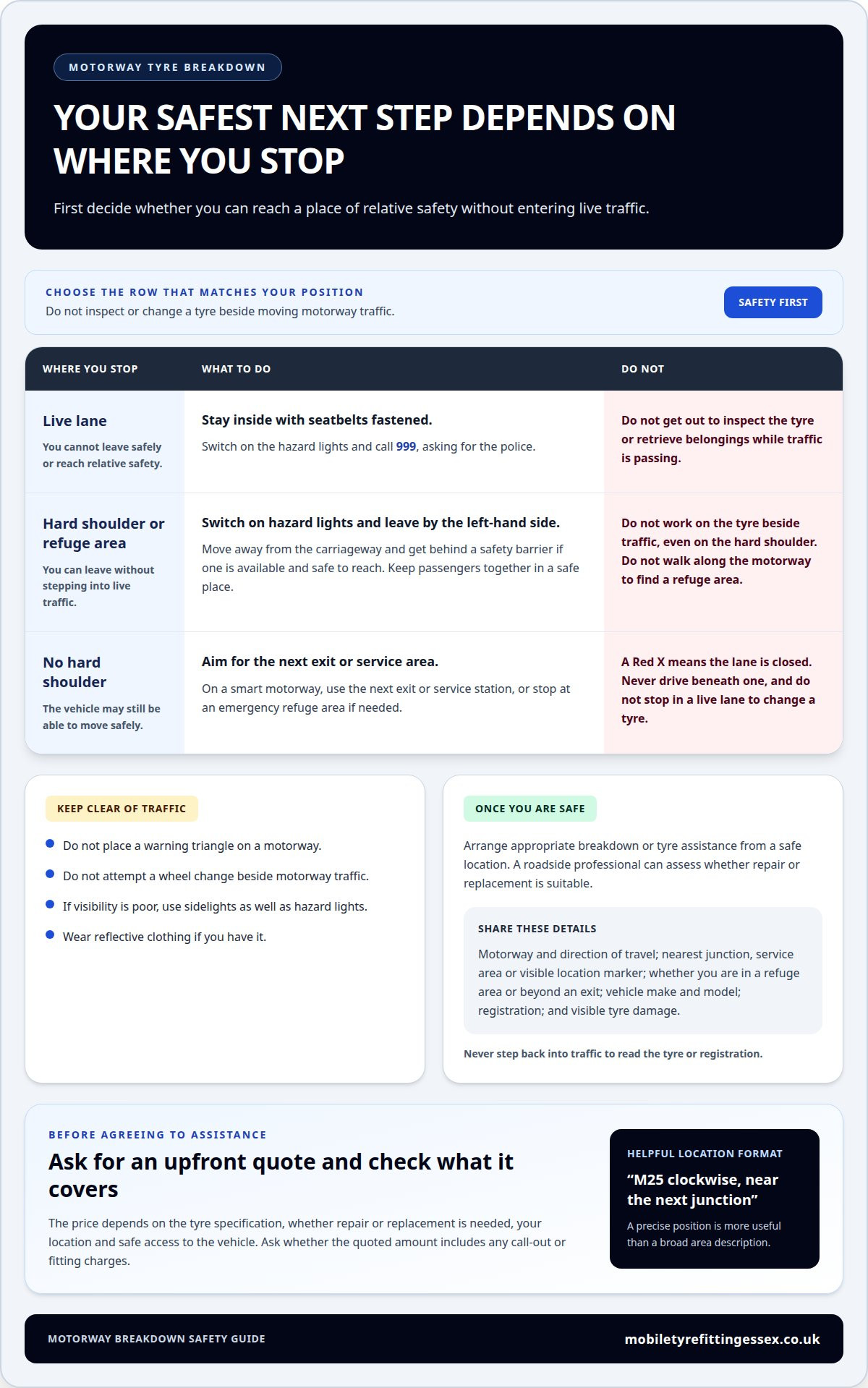
Choosing what to do based on where the vehicle stops
Your safest next step depends on whether the car can reach a place away from moving traffic. Check your position first, then choose a response that suits it.
Choosing a Stopping Place After a Puncture
Should I use a motorway emergency area or hard shoulder for a flat tyre? On a smart motorway, aim for the next exit or service station, or use an emergency refuge area if needed. On other motorways, try to reach a junction or service area; if you can’t, pull onto the hard shoulder.
The safest option is a service area or exit you can reach without putting the car or its occupants at risk. If that isn’t possible, an emergency refuge area on a smart motorway provides a place to stop away from a live lane. A hard shoulder is a fallback where available, not a place to inspect or change a tyre beside traffic.
If the vehicle stops in a live lane, don’t attempt to drive across traffic to reach a safer space. Don’t get out to examine the wheel or walk towards a refuge area. If you’re stranded and can’t reach relative safety or leave safely, call 999 and ask for the police, according to the Department for Transport.
Once stopped safely, note whether you’re at a refuge area, on the hard shoulder, in a service area or beyond an exit. This tells the person arranging help where the vehicle can be approached. Use a nearby location marker if you can read it safely, and give the motorway and direction of travel.
Responding to a Flat Tyre in London
What should I do if I get a flat tyre on a motorway in London? Keep control, slow down safely and try to reach the next exit or service area. If you stop in a live lane and can’t get to safety or leave safely, stay inside, fasten seatbelts, switch on hazard lights and call 999 for police assistance.
After stopping safely, switch on your hazard lights and leave through the left-hand side if it’s safe. Move away from the carriageway, preferably behind a safety barrier where one is available and safely reachable. Don’t put out a warning triangle or attempt a tyre change beside motorway traffic.
Where is the safest place to stop after a tyre puncture on a UK motorway? Choose a service area or exit if you can reach one safely. Otherwise, use an emergency refuge area on a smart motorway, or the hard shoulder where available.
For flat tyre on motorway assistance in London, give the motorway name, direction, nearest junction and location marker details. Explain whether the vehicle is in a refuge area, on the hard shoulder or in a service area. If traffic conditions or a live lane make your position dangerous, contact emergency services rather than trying to arrange a tyre repair first.
Mobile tyre fitting after a motorway puncture
Mobile assistance is appropriate once you and the vehicle are in a safe, accessible place. A technician can assess the damaged tyre and decide whether repair or replacement is suitable. The decision depends on the puncture’s position, the tyre’s condition and whether it has been driven while deflated. A visible puncture alone doesn’t establish that a repair is safe.
Before arranging help, prepare the vehicle’s make, model and registration. Share the tyre size if you can read it safely, and describe what happened: sudden pressure loss, visible damage or a dashboard warning. Give the motorway, direction of travel and precise stopping place. If you need assistance in London after a flat tyre on a motorway, identify a service area or refuge area rather than giving only a broad location.
Can breakdown cover change a flat tyre on a motorway in London? A breakdown provider may change a wheel or arrange recovery, depending on your policy and the vehicle’s safe location. Don’t attempt a change beside motorway traffic. Once safely stopped, ask what your cover includes and whether tyre repair or replacement is covered.
Mobile fitting is a practical next step when your vehicle is parked somewhere safe for a technician to work. The tyre can be inspected at that location, avoiding a journey on a damaged wheel. If repair isn’t suitable, a replacement must match the vehicle’s requirements. Share details about the existing tyre, including its size and type, when arranging the work. Speed Rating is optional when selecting a tyre.
A space-saver or run-flat tyre doesn’t remove the need to assess damage. Don’t rely on a universal run-flat allowance of 50 miles at 50 mph. The permitted speed and distance after pressure loss depend on the tyre and vehicle manufacturers, tyre size, vehicle load and damage. Follow the relevant vehicle and tyre guidance, then arrange an assessment rather than assuming you can continue safely.
- Arrange work only once the vehicle is safely accessible.
- Provide the exact location, vehicle details and tyre symptoms.
- Let the tyre’s condition determine whether repair or replacement is suitable.
- Don’t treat a temporary spare or run-flat tyre as a permanent solution.
For a London puncture, the stopping place affects whether assistance can reach the vehicle and work safely. A service area or other safe parking position offers a different setting from a refuge area. Explain any access restrictions when arranging help. Keep your phone available in case the responder needs clearer directions.
If you’re arranging flat tyre on motorway assistance in London, share your safe location and tyre details first. Arrange tyre assistance once the vehicle is safely accessible. Keep passengers away from the work area and follow the technician’s directions while the vehicle is attended.
Mobile Tyre Fitting Essex: Mobile Tyre Fitting
Mobile Tyre Fitting Essex can help once your vehicle is in a safe, accessible place in Essex and nearby areas. Its mobile tyre fitting service brings assistance to the vehicle, with a Puncture Repair Service when the damage is suitable for repair. If replacement is needed, share your vehicle details and tyre information when arranging help.
For an urgent tyre problem, 24-Hour Emergency Tyre Fitting offers a next step after you’ve secured the vehicle and passengers. If a locking wheel nut key is unavailable or the nut is seized, Locking Wheel Nut Removal can also help with access to the wheel.
Contact Mobile Tyre Fitting Essex to discuss the tyre issue and arrange assistance.
Take the Next Step Towards Getting Back on the Road
A motorway puncture can leave you weighing up several decisions at once. Keep the next move simple: deal with any immediate danger first, then arrange tyre assistance suited to your vehicle’s situation. If you need help with a flat tyre on a London motorway, focus on reaching a safe point where the vehicle can be attended to. That gives you room to consider your options without taking risks beside moving traffic.
Once you’re ready to arrange help, explain what you need and where the vehicle is. Mobile Tyre Fitting Essex offers mobile tyre fitting, 24-Hour Emergency Tyre Fitting and a Puncture Repair Service. Sharing clear details helps start a focused conversation about the support you’re seeking.
Contact Mobile Tyre Fitting Essex to discuss your tyre assistance needs and take the next step with confidence.
Frequently Asked Questions
Need Help Now?
If anyone is in immediate danger, call 999; if the car is safely stopped, arrange breakdown or tyre assistance. Tell the call handler your motorway, direction of travel, nearest junction and vehicle details. If you’re in a live lane and can’t reach safety or exit safely, remain inside with seatbelts fastened and ask for the police. Don’t delay an emergency call to inspect the tyre or find documents.
Can You Drive to the Next Motorway Services With a Flat Tyre?
Don’t drive on a visibly flat tyre to reach motorway services. A deflated tyre can affect control and become more damaged as the wheel turns. If the tyre is losing pressure but the car remains controllable, aim for a safe exit or service area only if you can do so without risk. Otherwise, stop at the safest reachable place and arrange assistance.
Can the Motorway Puncture Be Repaired, or Will the Tyre Need Replacing?
A technician must assess the puncture’s position and the tyre’s condition to decide what’s suitable. Damage in the tread may be repairable, while sidewall damage or driving on a deflated tyre can mean replacement is needed. For example, a small object in the tread doesn’t by itself prove the tyre is safe to repair. Share what happened and any pressure warnings when arranging an inspection.
How Do You Safely Leave a Motorway Emergency Area After the Tyre Is Fixed?
Leave only when the vehicle is ready and the exit route is clear. Follow signs and instructions at the emergency refuge area, check mirrors and blind spots, then build speed appropriately as you rejoin traffic. Don’t pull out if the tyre warning remains active or the vehicle feels unstable. If you’re unsure the repair has resolved the problem, stop safely again and arrange further help.
What If Your Car Stops in a Live Motorway Lane?
If you’re stranded in a live lane and can’t reach relative safety or leave safely, stay inside with your seatbelt fastened, switch on hazard lights and call 999 for the police, according to the Department for Transport. Don’t open a door to inspect the wheel or retrieve items. Tell the operator your motorway, direction and nearest location marker if you can see it safely.
How much does emergency motorway tyre assistance cost in London?
Mobile Tyre Fitting Essex provides transparent pricing with no hidden fees and a no-obligation quote. The quote reflects the requested work, including the tyre specification, whether repair or replacement is needed, the vehicle and safe access at your location. Describe the damage and give your exact location so the quote can cover the service you need.
Which London motorway breakdown services offer mobile tyre fitting?
Mobile Tyre Fitting Essex provides mobile tyre fitting across Essex and nearby areas. Its services include emergency tyre fitting and puncture repairs, with help arranged for a safe, accessible location. If your vehicle is stopped in London, give the exact motorway, direction and stopping point when discussing the job. The precise location matters for understanding whether the vehicle can be reached safely.
What should I do if my car has no spare tyre or a run-flat tyre?
If there’s no spare, don’t improvise a wheel change; arrange tyre assistance from a safe location. With a run-flat, follow the instructions for your specific tyre and vehicle rather than assuming you can continue for a set distance. Pressure loss, vehicle load and the type of damage all affect what’s suitable. Explain the run-flat warning and tyre details when requesting help. Speed Rating is optional when selecting a replacement tyre.
