
A truck tyre failure in London can be dealt with at any hour: emergency mobile tyre fitting is available 24 hours a day throughout the year. A 24 hour truck tyre service in London can assess the damage at the roadside and help determine whether a repair or replacement is the right solution. The aim is to get your vehicle safely moving again with less disruption to your journey or operation.
A puncture or damaged tyre can leave a truck stranded at the roadside, in a depot or at another location. You need clear information about what happens next, not guesswork. This guide explains how emergency callouts work, what technicians consider when assessing a tyre, and what can affect the service and its cost. You’ll also learn what details to share when arranging assistance, how mobile fitting supports commercial vehicles, and when a repair may be suitable instead of a replacement. With the process laid out step by step, you can make a practical decision and understand the support available when a tyre problem stops your vehicle.
Key Takeaways
- Emergency mobile tyre call-outs can assess a truck tyre at the roadside or another accessible location, then determine whether repair or replacement is suitable.
- Share your exact location, vehicle details and tyre information when arranging help to make the call-out easier to plan.
- Tyre condition, size and the type of vehicle all influence the repair or replacement needed for an HGV, lorry or articulated vehicle.
- London coverage and surrounding areas can affect the journey to your vehicle, so give a precise location when requesting assistance.
- Mobile fitting and puncture repair can help get a truck back on the road without moving it to a fitting centre.
Why Choose Mobile Truck Tyres London?
A truck tyre failure can stop a delivery, disrupt a shift or leave a vehicle stranded. In London, emergency mobile tyre fitting is available 24 hours a day throughout the year. A 24-hour call-out brings tyre assistance to the vehicle, rather than requiring it to reach a fitting centre first.
Start by giving clear details about the vehicle and its location. Share the truck or lorry type, the tyre position and any visible damage, then say whether it is at a roadside, depot or distribution centre. Give the postcode, site name and access instructions. Details such as a loading-bay location, restricted entrance or nearby junction help the technician find the vehicle.
At the vehicle, the technician assesses the tyre and considers whether a puncture repair or tyre replacement is appropriate. The decision depends on the damage, tyre condition and whether the affected area can be repaired safely. If replacement is needed, the tyre size and specification help identify a suitable match. After fitting, pressure is checked as part of preparing the tyre for use.
Mobile fitting can also suit scheduled work at a depot or distribution centre. Instead of arranging a vehicle’s journey to a tyre centre, operators can organise fitting at the truck’s location. This can help fit planned work around vehicle movements. For an emergency call-out, give the technician the entrance to use and the truck’s exact position on site.
For a London operator, the practical value is clear: assistance can come to the vehicle at a time when many workshops are closed. Availability does not mean every call-out takes the same number of minutes. Location, access, traffic, tyre size and the work required all shape the timing. Give accurate details at the start so the call-out can be planned around the actual job.
Use these steps to prepare for an emergency tyre call-out:
- Move the truck to a safe, accessible position if it can be done safely.
- Record the exact location, including a depot bay or distribution-centre entrance.
- Describe the tyre damage and identify the affected wheel where possible.
- Keep the vehicle details and tyre information ready to support the assessment.
This information helps distinguish a repair from a replacement and supports efficient tyre fitting at the roadside or on site.
Emergency tyre repairs and replacements
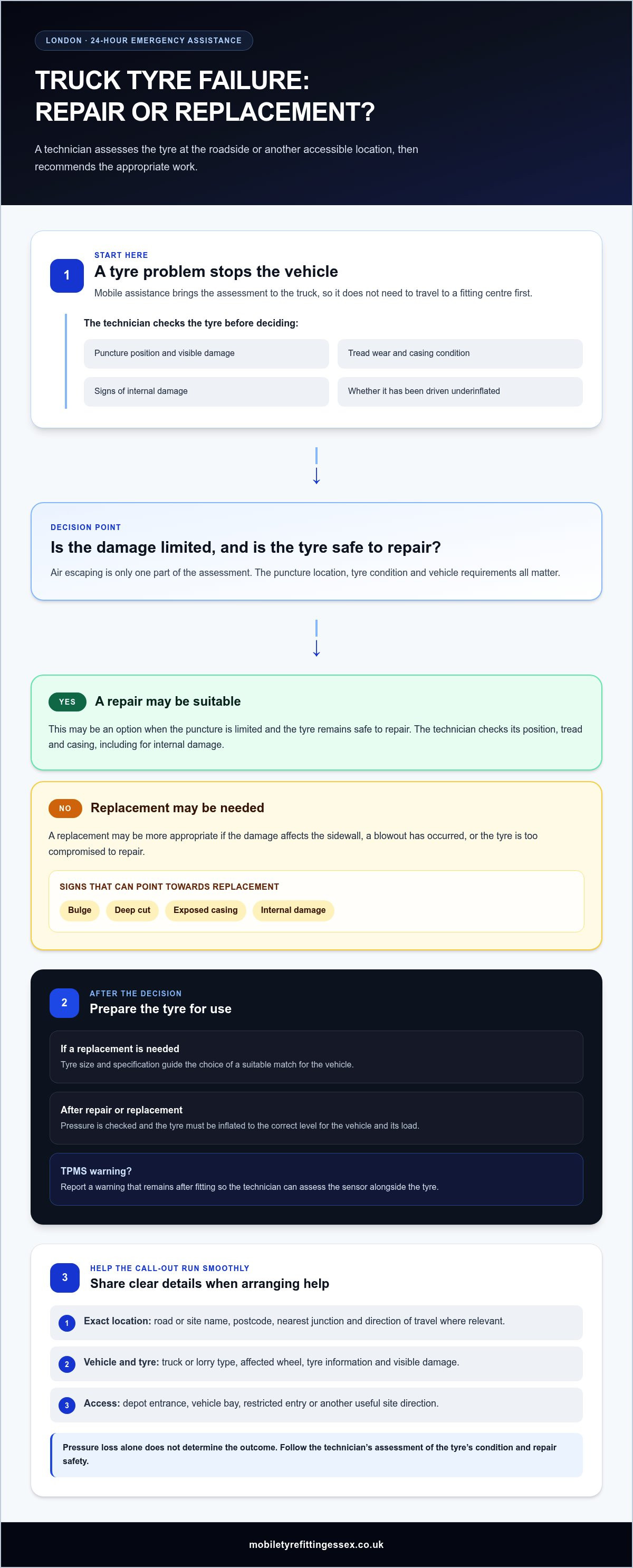
After a puncture or blowout in London, the key decision is whether the tyre can be repaired or needs replacement. A technician assesses the damage, tyre condition and vehicle requirements before deciding on the appropriate work.
Puncture Repair or Tyre Replacement
A puncture repair may be suitable when the damage is limited and the tyre remains safe to repair. The technician assesses the puncture’s position, tread condition and any signs of internal damage. Replacement may be needed if damage affects the sidewall, a blowout has occurred or the tyre is too compromised to repair. Tyre size and specification guide the replacement choice. The replacement tyre should be suitable for the vehicle.
Roadside and On-Site Puncture Repairs
A roadside or on-site assessment brings the service to the truck, without requiring a journey to a fitting centre. When arranging an emergency call-out, share the vehicle’s location, tyre position and visible damage. At a depot or delivery site, identify the entrance and the truck’s exact position. These details help the technician locate the vehicle and prepare for the job.
Safety Criteria for Puncture Repairs
Whether air is escaping is only one part of assessing a tyre. A technician considers the puncture location, tread wear, casing condition and whether the tyre has been driven while underinflated. For example, a small-looking tread puncture may be accompanied by internal damage after pressure loss. A bulge, deep cut or exposed casing can also mean replacement is more appropriate than repair.
After repair or replacement, pressure matters. The tyre must be inflated to the correct level for the vehicle and its load, using the vehicle’s specified pressure information. A TPMS warning may also need attention if the sensor has been affected. If a warning remains after fitting, report it during the call-out so the technician can assess the sensor alongside the tyre.
Puncture Repairs and Tyre Recycling
When a replacement is necessary, the removed tyre becomes part of the job’s environmental footprint. Tyre recycling can recover materials for other uses, while some casings may be suitable for retreading after assessment. The tyre’s condition determines its next route. A damaged casing from a blowout may not be suitable for the same recovery option as an intact tyre.
For a puncture at the roadside or on site, choose the repair or replacement route based on the technician’s assessment, not pressure alone. A mobile puncture repair service can bring the assessment to the vehicle, including during an emergency call-out.
Service coverage in London and surrounding regions
For a London tyre call-out, the vehicle’s exact location, site access and work required all matter. Whether the truck is at an airport, motorway, service station, depot or roadside, give clear directions to help the technician find it.
London and surrounding-area coverage
In a large city, a precise location is more useful than a broad area name. Give the road or site name, nearest junction, direction of travel and a recognisable landmark. At a depot, include the entrance and vehicle bay. On a motorway, share the carriageway direction and nearby junction or marker when it is safe to do so.
Journeys around Essex and nearby areas can involve different routes and access arrangements. A vehicle near London may be closer by road to Essex or Kent than to central London, while Cambridge is another regional location. Share the postcode and exact position when arranging assistance so the team can assess the location and route.
Airport, motorway and service-station call-outs
Airports such as Heathrow have designated entrances, internal roads and controlled vehicle areas. Give the terminal, car park, loading point or access gate rather than simply saying “the airport”. At a service station, name the site and parking area. During a motorway breakdown, prioritise your safety and follow the site’s instructions before sharing your location.
Access can affect how quickly a technician reaches the tyre. A locked depot gate, restricted loading bay or busy service-station forecourt may require additional directions. Tell the call handler if the truck is difficult to reach or cannot move. This helps the team understand whether it is a straightforward roadside stop or a vehicle inside a restricted site.
Average response time and practical factors
An advertised average response time for London mobile tyre assistance is 45 minutes. That is an average, not a precise arrival time for every call-out. Traffic, distance, access, the technician’s location and the tyre required can all affect the journey. A call near a major route may still take longer if congestion or a site restriction changes the approach.
Planning also depends on the work required. A puncture repair differs from a replacement, and a locking wheel nut issue may add another task. Give the tyre size, wheel position and vehicle type if you know them. Describe any pressure loss or visible damage clearly so the technician can prepare for the right work and equipment.
To make the location easier to find, provide:
- The postcode, road name or named site.
- The direction of travel and nearest junction, where relevant.
- A terminal, gate, bay or parking-area reference for large sites.
- A clear description of access restrictions or vehicle position.
Accurate directions and a clear description of the damage help arrange the appropriate tyre repair or replacement at the vehicle’s location.
24/7 Emergency mobile tyre assistance
A truck tyre emergency can happen during a night delivery or an early depot run. Emergency mobile tyre assistance is available 24 hours a day throughout the year, bringing tyre support to the vehicle’s location. A 24 hour truck tyre service in London can help address a failure without waiting for normal workshop hours.
Start by explaining the immediate problem. Say whether the tyre is losing pressure, visibly damaged or completely flat, and identify the wheel if possible. A blowout on a delivery route needs a different assessment from a slow puncture in a depot. Clear information helps the call handler understand the assistance required.
Next, give the exact location and access details. Name the road, direction of travel and nearest junction, or provide the depot entrance and bay. If the truck is behind a gate or in a loading area, explain how the mobile tyre technician can reach it. Precise directions help avoid delays searching a large site.
The technician assesses the tyre before deciding on the work. A puncture may be repairable, while sidewall damage, a blowout or a compromised casing may call for replacement. Tyre size and vehicle type matter when matching a suitable tyre. Share any size details visible on the tyre, but do not approach a damaged wheel if doing so would put you at risk.
A mobile tyre fitting vehicle carries tools and equipment for on-site work, but the replacement still needs to match the truck’s specification. Tell the call handler about unusual tyre dimensions, twin-wheel positions or other details that could affect the job. If a wheel nut is damaged or its locking key is missing, mention that when arranging assistance.
Use this short checklist during the call:
- Give the truck’s location and a clear access point.
- Describe the tyre position and visible damage.
- Provide the vehicle type and tyre size, if available.
- Report locking wheel nut problems or a TPMS warning.
A customer review describes a fitter attending at 11pm, showing how a call can arise outside normal workshop hours. That example isn’t a promised arrival time. Traffic, distance, site access and the tyre needed shape each response. For a 24 hour truck tyre service in London, accurate details help the technician plan the call-out around the actual breakdown.
For a fleet controller, one clear call can also help coordinate a replacement vehicle or adjust a delivery plan. Keep the affected truck, driver contact and site access details together. This gives the person arranging assistance a practical picture of the breakdown, whether it happens at a customer site, depot or roadside.
Tyres for HGVs, lorries and articulated vehicles
HGVs, rigid lorries and articulated vehicles need tyres matched to the vehicle and wheel position. A replacement must suit the required size and specification, not just look similar to the damaged tyre. When arranging an emergency call-out, share the vehicle type, tyre markings and affected axle.
Tyre size is usually printed on the sidewall. Record the full marking, including letters and numbers, and note whether the wheel is single or part of a twin-wheel set. If the sidewall is damaged or unreadable, provide the truck’s make and model. These details help identify a suitable replacement rather than relying on a partial size match.
Brand preference can also matter to fleet operators managing consistent specifications across vehicles. Still, the vehicle’s requirements and the tyre’s intended position come first. A steer axle, drive axle and trailer axle can have different roles. Don’t assume a tyre suitable for one position is automatically right for another.
Run-flat tyres require careful matching because their construction and intended use differ from standard tyres. Tell the technician if the truck uses run-flat tyres or if you are unsure. The same principle applies to other specialist fitments: share the existing tyre and vehicle details before selecting a replacement.
Tyre condition matters beyond a single puncture. For commercial vehicles over 3,500kg, the stated UK tread requirement is at least 1.6mm across the central three-quarters of the tyre. Inspecting tread depth can help identify wear that may affect the choice of replacement. A cut, bulge or exposed casing also needs assessment, especially after a blowout.
Buses and coaches have their own vehicle requirements, although correct tyre size, position and condition matter for them too. Don’t assume a truck tyre specification suits a passenger vehicle. Give the vehicle type and tyre markings so the fitting requirements are clear from the outset.
Before arranging HGV lorry and truck tyres, gather these details:
- Vehicle make, model and whether it’s rigid or articulated.
- Full tyre sidewall markings and the affected wheel position.
- Any known run-flat fitment or fleet brand preference.
- Visible damage, including a cut, bulge or blowout.
These details help focus the call-out on the right tyre specification. Request HGV and truck tyre assistance for a damaged or worn commercial tyre.
Mobile Tyre Fitting Essex: Mobile Tyre Fitting
Mobile Tyre Fitting Essex provides mobile tyre fitting, puncture repairs and 24-hour emergency tyre fitting. For a truck with a damaged tyre, this means arranging assistance at the vehicle’s location instead of driving to a fitting centre.
Request the Puncture Repair Service when a technician needs to assess a puncture, or replacement support if the tyre is damaged beyond repair. Mobile Tyre Fitting Essex also provides Locking Wheel Nut Removal when a locking nut prevents wheel removal. Share the vehicle type, tyre details and exact location when arranging assistance.
For a truck tyre problem in London, contact Mobile Tyre Fitting Essex to discuss the assistance you need.
Prepare your team for the next tyre incident
Make the next call easier to organise by adding a tyre incident note to your dispatch process. Record each vehicle’s registration, tyre markings, wheel position and usual operating locations, along with the person authorised to arrange work. Drivers can then share consistent details during an unexpected stop, while fleet teams keep a clear record of tyre issues.
Use those records to spot repeat problems across particular vehicles or routes. For example, recurring damage on one truck may prompt a closer review of its tyre condition during routine fleet checks. A clear process also helps drivers know what information to share, without delaying the initial call to report a breakdown.
If a truck is immobilised in London, a 24 hour truck tyre service in London can help arrange on-site tyre assistance. Mobile Tyre Fitting Essex offers mobile tyre fitting, emergency tyre fitting and puncture repairs for tyre problems that stop a vehicle.
Contact Mobile Tyre Fitting Essex today to discuss the tyre support you need. A clear account of the vehicle and its location is a practical start.
Frequently Asked Questions
How fast can you reach a stranded truck?
Arrival time depends on the truck’s position, road conditions, access and tyre required. A breakdown beside a clear depot entrance differs from one inside a restricted loading area. Give the postcode, road direction or site entrance, along with the vehicle and tyre details. This helps the team plan the route and prepare for the job instead of losing time locating the truck or identifying its requirements.
NEED HELP NOW?
Call Mobile Tyre Fitting Essex on 07510 635870 for emergency tyre support. The emergency service operates around the clock for tyre emergencies. Explain whether the truck has a puncture, a flat tyre or visible damage, then provide its location and vehicle details. If speaking is difficult at the roadside, use the listed email address, mobiletyresessex@icloud.com, when practical. Keep the phone available for directions or service updates.
What commercial vehicles do you cover?
Mobile tyre support covers vans, HGVs, lorries and trucks, as well as cars. For example, a fleet manager can arrange help for a delivery van or a heavy goods vehicle with a damaged tyre. Give the vehicle type, make and model, then share the tyre markings if visible. These details help distinguish the fitting requirements for a van from those of a truck or lorry.
What areas of Greater London do 24-hour truck tyre services cover?
Mobile Tyre Fitting Essex states its service area as Essex and nearby areas. Greater London borough coverage should not be assumed from that description alone. When arranging assistance, give the exact postcode and site name, such as a depot or distribution address. This makes the location clear and helps establish whether it sits within the stated local area, without relying on a broad label such as “London”.
How quickly can a mobile truck tyre fitter reach a breakdown in London?
The journey time depends on the breakdown’s precise position, traffic, site access and the tyre required. A truck at an accessible roadside location presents different routing needs from one behind a depot gate. Provide the nearest junction or entrance, direction of travel, vehicle type and tyre details. These specifics help the team assess the route and prepare for the correct fitting work before setting out.
Can London mobile tyre services repair truck tyres roadside or only replace them?
Truck tyre assistance may involve a puncture repair or replacement, depending on the technician’s assessment. A puncture in an area suitable for repair is different from a sidewall cut or blowout. The tyre’s condition and damage determine the appropriate option. A technician can assess the tyre where the vehicle is stopped and explain the work needed before carrying out the repair or replacement.
What information is needed when calling for emergency truck tyre assistance?
Share the exact location, truck type, affected wheel and a clear description of the damage. If possible, read the full tyre size from the sidewall and mention any locking wheel nut issue or TPMS warning. For a fleet vehicle, provide its registration and the person arranging the work. At a large site, include the entrance, bay or loading area so the technician can find the truck.
What are the safety steps for a truck tyre breakdown on a London road or motorway?
Put people’s safety first. If the truck can be moved safely, get it away from moving traffic and follow the road signs or site instructions. Keep clear of the damaged wheel and avoid standing where approaching traffic could reach you. Share your location from a safe position. On a motorway, use the nearest designated roadside help point if it is safely accessible, and tell the tyre team where you are.
